Welcome to WELTIN

info@weltin.com

+91 9958280807

Home / One Person Company

One Person Company

Empowering Solo Entrepreneurs to Build a Corporate Identity.

One-Person-company

Why Choose WELTIN ?

Expert Guidance

Our experienced team handles everything from paperwork to submission.

Quick & Efficient Service

We ensure your company is registered swiftly without unnecessary delays.

End-to-End Support

WELTIN offers full support, from registration to compliance and business expansion.

Calculate Your Business Setup Cost

1
2
3
4
5
Status
Sector’s in India are- (in which sector you want to set up?)
Promoters or Owner
Office space
Contact Details

Our Compliance Services

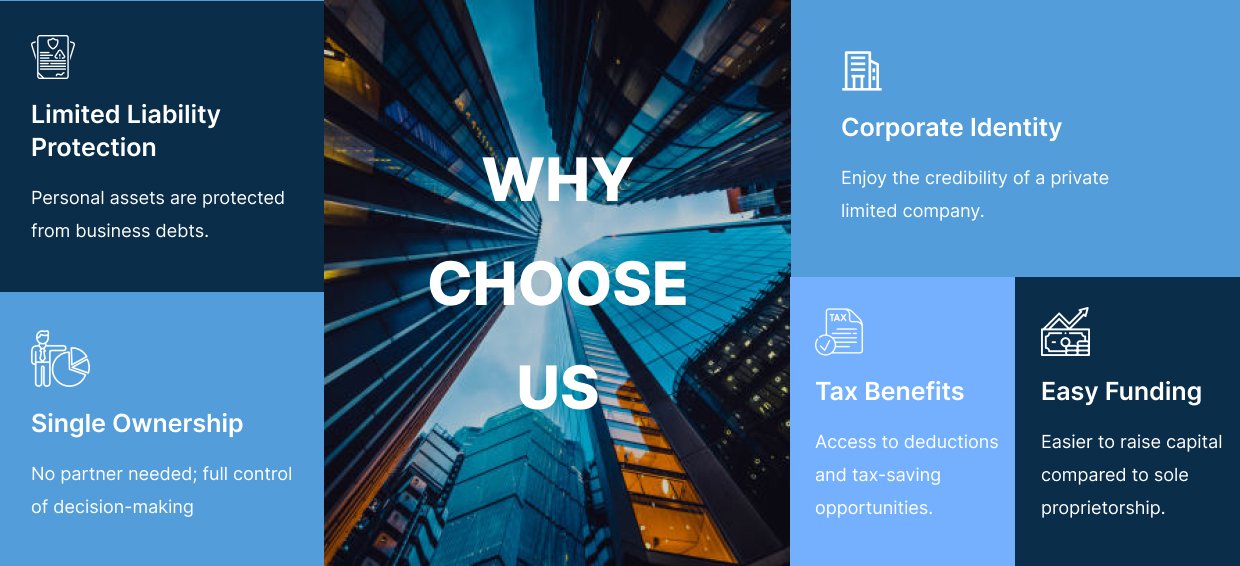
Limited Liability

1. Personal assets are protected from business debts.
2. Separates personal and business finances for better protection

Corporate Identity

1. Provides a professional business image.
2. Enhances credibility and trust with clients and investors.

Tax Benefits

1.Take advantage of corporate tax structure and deductions.
2.Provides better financial planning and tax-saving opportunities.

Easy Funding

1. Simplifies raising capital from investors.
2. Enables easier access to financial resources for growth.

Service Overview

OPC -Meaning & Eligibility

An OPC (One Person Company) is a business structure that allows a single individual to run a company with limited liability. Any Indian citizen who is a resident of India (stays for at least 182 days in the previous calendar year) can start an OPC. Minors, non-residents, and individuals already part of another OPC as a member or nominee are not eligible.
An OPC must file annual returns and financial statements with the Registrar of Companies (RoC). It is required to hold at least one board meeting every half-year, ensuring minimal operational complexity. Additionally, OPCs must maintain proper books of accounts, and if the turnover exceeds ₹2 crore, an audit is mandatory.
OPCs are taxed like private limited companies at a corporate tax rate of 25% for turnover up to ₹400 crores. They also qualify for exemptions and deductions under the Income Tax Act, which allows for more tax-efficient operations.
To register an OPC, the required documents include the PAN card and Aadhaar card of the owner and nominee, proof of the registered office address such as utility bills, and a Digital Signature Certificate (DSC) for the director. Additionally, the Memorandum of Association (MOA) and Articles of Association (AOA) must be submitted for incorporation. These documents ensure that the OPC is compliant with legal registration requirements.
The limited liability feature in an OPC protects the owner’s personal assets from the company’s liabilities. In case of business losses or debts, only the capital invested in the business is at risk, not personal property. This provides financial security for the business owner, allowing them to grow the business with less personal financial risk.

Our Expertise

0

Successful Registrations Completed

0

Countries Served

0

Years of Industry Expertise

24 / 7

Client Support Available

Frequently Asked Question

Yes, OPC is ideal for small businesses or solo entrepreneurs who want to enjoy limited liability while maintaining full control over the business.

Only a resident Indian citizen who has stayed in India for at least 182 days in the previous year can form an OPC. Non-residents and minors are not eligible.

No, an OPC can only have one member, but it can have a nominee to represent the member in case of their death or incapacity.

An OPC must convert if its turnover exceeds ₹2 crores or if its paid-up capital surpasses ₹50 lakhs.

There is no minimum paid-up capital requirement for forming an OPC, although the company must have at least one shareholder and one director.

FAQs
WhatsApp
1